
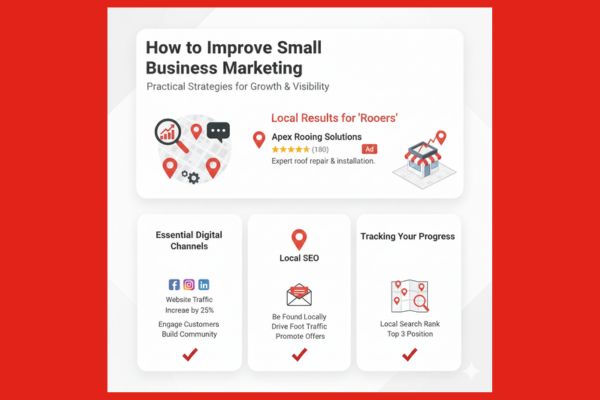
How to Improve Small Business Marketing (Simple 3-Step Plan)
How to Improve Small Business Marketing (Without Getting Overwhelmed)
Most small business owners feel stuck with marketing.
You know you need more calls.
You want better customers.
You’d like Google to actually show your business.
But marketing feels like a huge, confusing mountain. Everywhere you look someone says you need something new—ads, social media, email, SEO, video. It sounds expensive and complicated, and most owners are already busy just running the business.
Here’s the truth:
You do not need to do everything. You need a simple system that fits real life and grows over time.
This is the same approach I teach small service businesses inside The Marketing Mountain. It works even if you only have a couple hours a week and no marketing background.
TL;DR – The Simple Plan
If you only remember a few things, remember this:
Start with Google Business Profile.
Make simple videos that answer customer questions.
Turn those videos into blogs using AI.
Stay consistent instead of trying to be everywhere.
That’s it. No fancy tricks. Just steady, helpful marketing.
The 3 Biggest Marketing Mistakes Small Businesses Make
Mistake 1 – No Google Business Profile
Google Business Profile is the front door of your online presence. It tells Google who you are, what you do, and where you serve. When it’s missing or wrong, Google has no confidence in sending you leads.
I still meet businesses every week that either don’t have GBP at all or haven’t touched it in years. Their address is old, services are missing, photos are from 2018, and they wonder why the phone is quiet.
Think about it like this:
If your physical store had no sign, no hours on the door, and no way to tell what you sell, customers would walk right by. That’s what happens online without GBP.
Mistake 2 – Talking About the Business Instead of the Customer
Most marketing sounds like a company resume. Owners talk about how long they’ve been in business, how great their service is, and how much they care. None of that is bad, but it isn’t what makes a customer call.
Here’s a simple test I teach:
Look at your website or posts and count how often you say “I” or “we.”
Then count how often you say “you.”
Good marketing talks to one person, not to a crowd. It should feel the same way you talk to a customer on the phone or across a coffee table. The tone should be calm, helpful, and focused on their problem.
Remember, the customer already has a question in their mind. Your job is to step into that conversation and answer it clearly.
Mistake 3 – Trying to Do Everything at Once
Owners hear that they need Facebook, Instagram, TikTok, email newsletters, paid ads, blogs, and videos. So they try to juggle all of it. After a few weeks they feel behind, guilty, and exhausted—and they stop completely.
Marketing works best when you choose one main path and walk it consistently. You can add more later, but you need a strong foundation first.
If You Only Have 2 Hours a Week, Do This
Step 1 – Get Google Business Profile Right
This is the first domino.
Make sure your business name, address, and phone are correct. List your services in plain language. Add real photos of your work and your team. Post something once a week so Google knows you are active.
Also pay attention to your service area and locations. If you travel to customers, tell Google exactly where you serve. If you have an office, make sure the map pin is correct. Small details like this make a big difference in who sees you.
I’ve watched this step alone bring results. A concierge nurse in The Marketing Mountain followed about sixty percent of the GBP lesson. Within forty-five days she was getting real client calls. No ads, no complex funnels—just Google Business Profile done the right way.
Step 2 – Make Simple Videos
You do not need commercials.
You do not need a studio.
You just need to talk.
Every day new clients call your business with questions. I would bet that eighty percent of those questions are the same over and over. The last twenty percent are unique to their situation.
Start by writing down those eighty-percent questions. That list is pure gold. It is exactly what people are typing into Google and YouTube.
When you record, pretend you are talking to one customer on the phone. Use the same words you would use in real life. Don’t try to sound like a TV announcer. Helpful beats perfect every time.
Step 3 – Turn Videos into Blogs (No Writing Required)
Most people think blogging means sitting at a keyboard and writing for hours. That’s the hard way.
Instead, let the video do the heavy lifting.
Record the video first.
Create a transcript of what you said.
Then give that transcript to your favorite LLM—ChatGPT, Claude, Grok, or whatever you like.
The AI isn’t inventing some generic article. All the ideas, priorities, and opinions came from you in the video. The LLM simply helps you organize it, smooth the language, add headings, and make sure Google can understand the topic.
In a few minutes your spoken answer becomes a full blog post of fifteen hundred to two thousand words. One piece of work turns into many: a YouTube video, a blog, social clips, and posts for Google Business Profile. That’s smart marketing without extra stress.
Organic vs Paid Ads
Paid ads can be useful, but they are like a light switch. When the budget stops, the leads stop. Organic marketing is more like planting trees. It grows slowly at first, but it keeps producing year after year.
The best plan for most small businesses is simple: build organic as your foundation and use ads only to support it. The good news is that almost all organic marketing can be done in-house with basic tools.
What “Marketing Working” Really Looks Like
You will notice more than just traffic numbers. The phone calls change. People start asking detailed questions that match exactly what you do. They reference a video or a blog they saw. They come in already trusting you.
Instead of price shoppers, you get buyers who say, “I saw your video about this problem and it sounds just like my situation.” That is when marketing is doing its real job—pre-selling you before the first conversation.
The Simple Tool Kit
You don’t need expensive gear. A modern smartphone, a YouTube channel, Google Business Profile, and an AI helper are enough to beat most competitors who are doing nothing at all. Fancy equipment can come later.
The Objections I Hear Most
Owners tell me they don’t have time, they hate being on camera, they don’t know what to say, or they hate the sound of their voice. Some worry about trolls or mean comments.
Here is the part most people forget:
When you start, nobody is paying attention.
You don’t have a following yet. The vast majority of the world doesn’t even know you exist, and they won’t see your first few videos. That is actually good news—you get to practice in peace.
And if something truly is bad, don’t post it. Nobody knows what ended up on the editing floor. You have to make blog and video number one to reach number ten and then number one hundred. By video ten you will feel comfortable, and by video twenty you will wonder why you waited so long.
Consistency Beats Talent
Marketing is not a talent contest. It is a habit.
One helpful video per week, one blog per week, and one Google Business post per week will slowly change how the internet sees your business. Over a year that becomes a library of answers working for you day and night.
FAQ
People ask the same questions about getting started.
You do not need expensive equipment; your phone is enough.
Videos should be about two to five minutes.
Talk about the questions customers already ask.
Paid ads are optional at first.
Being nervous on camera is normal and temporary.
AI can help turn your transcript into a real blog while keeping your voice.
Posting once a week is a great minimum goal.
Final Thought
Marketing is not about shouting louder than everyone else.
It is about being useful, clear, and consistent.
Answer real questions from real people, and your business will grow.
What to Do Next
1.Download the free guide
👉 Cracking the Code: 3 Ways to Figure Out What Your Clients Are Googling (And Turn It Into Awesome Videos!)
There are three ways to “read the minds” of your potential clients.Find out what they’re thinking, then write blogs, record videos, produce podcasts covering what’s on their minds.
Click here to download your copy now.
2.Consider The Marketing Mountain
If you want step-by-step help with Google Business Profile, simple videos, and turning them into blogs, that’s where we do it together.
If you want a DIY approach that will save you tons of money, join us in The Marketing Mountain.Use the free tools agencies don’t want you to know about…build up a few clients, get some cashflow, then buy the tools, resources, and subscriptions you can afford!“Put your business in front of your cash, not your cash in front of your business!”