
TL;DR – The Key Concepts
If you’re short on time, here’s the big picture:
- Most small business websites don’t have basic SEO set up at all.
In my experience, over 95% are missing it. - SEO is not about tricks — it’s about clarity.
- A few foundational elements (what I call “set-it-once SEO”) can put you ahead of the majority of your competitors.
- The Big 3 — title tag, meta description, and H1 — must support each other, not repeat each other.
- You do not need expensive tools, backlinks, or retainers to get started.
- SEO works best when it quietly supports your content and messaging over time.
If you do nothing else, do the basics well — and then move on.
Introduction: You’re Not Late — You’re Early Enough
If SEO feels overwhelming, you’re not alone.
Most small business owners I talk to feel like SEO is this massive, technical thing they somehow missed. Algorithms. Tools. Audits. Monthly retainers. It can feel like if you didn’t start five years ago, there’s no point now.
And honestly?
The best day to start SEO was probably six months ago.
If you had started then, it could already be helping you today.
But here’s the better news:
Today is the second-best day to start.
And you don’t need to do everything.
In fact, here’s something that surprises almost everyone:
In my experience, more than 95% of small business and service business websites don’t even have the basic SEO foundations set up correctly.
Not advanced stuff.
Not fancy stuff.
The basics.
That means you don’t need to be perfect. You just need to be clearer than most of your competitors.
In theory — and in practice — if you simply set up the fundamentals the right way, you can put your business ahead of the vast majority of others in your category without expensive tools, agencies, or long-term SEO contracts.
This article walks through the small business SEO basics that are actually worth doing early — so SEO quietly works in the background while you focus on building your business and bringing in cash.
What SEO Actually Does for Small Businesses
At its core, SEO helps the right people find you when they’re already looking for help.
It’s not about gaming Google.
It’s not about chasing trends.
And it’s definitely not about “outsmarting” an algorithm.
For service businesses especially, SEO works best when it:
- Makes it obvious who you help
- Explains clearly what you do
- Establishes trust quickly
- Supports helpful content over time
Good SEO removes friction. It answers questions before someone ever contacts you.
And when it’s set up correctly, SEO supports everything else you do — your website, your blog, your email list, your referrals, even word-of-mouth.
That’s why foundations matter so much.
The SEO Foundations Worth Setting Up Early
Let’s talk about what’s worth your time.
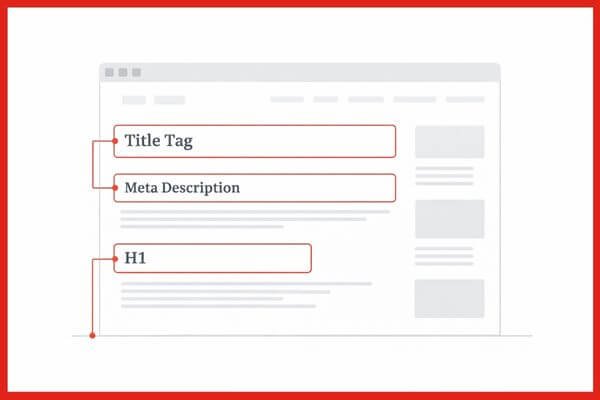
I’ve seen people refer to title tags, meta descriptions, and H1s as “The Big 3.”
I like that framing — with one important clarification.
They are not carbon copies of each other.
They should support, emphasize, and reinforce the same idea, but they shouldn’t say the exact same thing three times.
When written correctly, they’re greater than the sum of their parts.
The Big 3: Title Tag, Meta Description, and H1

Title Tags & Meta Descriptions (A Real Story)
Here’s a true story.
I once looked at a friend’s website and noticed their homepage title tag was literally just:
“Home.”
That doesn’t tell Google anything.
Out of curiosity, I clicked through to the website designer’s portfolio page to see some of their other clients. They had hundreds of websites listed.
Hundreds of clients they had built websites for.
Every single one of them?
Their homepage title was also:
“Home.”
About pages were all named “About”.Contact pages were all named “Contact Us”.
I’m talking pizza places, dry cleaners, churches, car washes, environmental groups…
If I were to say to you “Home”…which one am I talking about?You have no clue!
Same thing with Google.Here are over 1000 websites with a page named “Home”.What do they do?
With that one small mistake, you could theoretically outrank all of them just by writing a clear, descriptive title tag.
That’s how low the bar is.
What Title Tags Actually Do
Your title tag is the primary signal Google uses to understand what a page is about.
A good title tag:
- Describes the page clearly
- Uses plain language
- Matches what a human would search for
- Sets expectations accurately
It does not need to be clever.
It does not need to be stuffed with keywords.
Clarity beats creativity here every time.
What Meta Descriptions Do (and Don’t Do)
Meta descriptions don’t directly impact rankings, but they absolutely impact click-through rate.
Think of them as your “why should I click?” explanation.
A good meta description:
- Expands on the title
- Adds context
- Sounds human
- Makes the page feel helpful
It supports the title — it doesn’t repeat it.
How the Big 3 Work Together
Here’s the key idea most people miss:
- The title tag introduces the topic
- The H1 expands on it inside the page
- The meta description persuades the click
They should rhyme — not echo.
If you copy and paste the same sentence into all three places, you haven’t helped Google understand anything new.
But when they support each other, Google sees clarity.
And clarity wins.
H1s and Page Structure: Think “Outline,” Not “Design”

I like to explain page structure using an analogy most of us remember from school.
Think of your page like an outline you wrote in 9th grade.
- H1 = the main topic of the paper
- H2s = the major sections
- H3s = the supporting points within each section
If you’re listing things, the H2 introduces the list and the H3s are each item in that list.
And here’s the real test:
If I read only your H1, H2s, and H3s,
I should understand the gist of your page.
If that’s true?
That’s a major win — for humans and for Google 😉
Clear Website Messaging (More Important Than Keywords)
This might be the most underrated SEO basic of all.
Before worrying about keywords, your website needs to clearly answer:
- Who is this for?
- What problem do they solve?
- What should I do next?
When that’s unclear, SEO struggles — no matter how much optimization you do.
Confusion hurts rankings far more than missing a keyword.
Clear messaging helps:
- Users stay longer
- Pages convert better
- Google trusts your site more
SEO and messaging are not separate things. They support each other.
What You Do Not Need to Worry About Yet

This is where a lot of small businesses waste money — and where my personal philosophy really matters.
You do not need to worry about:
Advanced SEO tools
Many run $100–$250 per month or more, and most beginners use 10% of their features.
Backlink strategies
These can cost $50 to $500 per backlink — often with questionable quality.
Monthly SEO retainers
Depending on what’s included in your SEO package, these range from $1,500 to $5,000 per month.
“Secret” optimization tactics
This usually means black-hat SEO.
And when Google updates the algorithm (which it always does), those sites often drop from #1 to… well… oblivion.
These things aren’t scams.
They’re just not first.
SEO for Service Businesses: Why Simple Wins
For service businesses — roofers, painters, consultants, coaches, planners — SEO rewards trust and clarity.
Google wants to recommend:
- Legitimate businesses
- Clear experts
- Helpful answers
Not the flashiest sites or the biggest budgets.
Consistency beats intensity every time.
Helpful content, simple structure, and honest messaging go a long way — especially when most competitors haven’t done the basics.
How SEO Fits Into a Bigger Marketing Plan
SEO doesn’t live in a vacuum.
It works best when it supports a broader strategy that includes:
- Content
- Local visibility
- Trust-building over time
If you want to see how SEO fits into the bigger picture, start here:
👉best digital marketing for small business
SEO is a foundation — not the finish line.
Simple Next Steps (Keep This Boring on Purpose)
If you want to act on this article, here’s enough:
- Clean up your title tags and meta descriptions
- Make sure every page has one clear H1
- Improve your messaging
- Publish helpful content when you can
- Move on
You can always revisit SEO later. Progress now beats perfection later.
Frequently Asked Questions
How long does SEO take for a small business?
SEO is gradual. Foundations help quickly, but meaningful traction often takes a few months of consistency.
Can I do SEO myself?
Absolutely. Especially the basics. Many businesses should start DIY before paying for help.
Do keywords still matter?
Yes — but clarity matters more. Keywords support good messaging, not the other way around.
Should I hire an SEO agency right away?
Usually no. It’s often smarter to learn the basics first so you know what you’re paying for later.
Is SEO worth it for service businesses?
Yes — especially because your competitors often aren’t doing it at all.
You’re Not Behind — You’re Building Smart

SEO doesn’t reward panic.
It rewards clarity and patience.
By setting up the basics, you:
- stop losing ground
- build quiet momentum
- keep your business behind your cash — not ahead of it
A Calm Next Step
If you want to learn SEO and content the DIY-first, cash-smart way, that’s exactly what we work through inside The Marketing Mountain.
And if you want help turning these basics into real content, a Content Creation Call can shortcut the process when you’re ready.