
You've seen it a thousand times.
You search for a plumber, a life coach, or a landscaper near you — and there it is. A little box on the right side of the screen. Photos. Reviews. A phone number. Hours. A map.
That's a Google Business Profile. And here's what most service business owners don't realize: you have one too. Or you should.
Even more shocking? It's completely free.
·No monthly subscription.
·No setup fee.
·No "premium tier" to unlock the good stuff.
Google hands you a direct line to their search engine — at no cost — and most business owners either don't know it exists or set it up once and walk away.
That's a huge mistake.
And in this post, I'm going to walk you through the real benefits of Google Business Profile — and show you exactly why it deserves to be your first marketing move.
Table of Contents
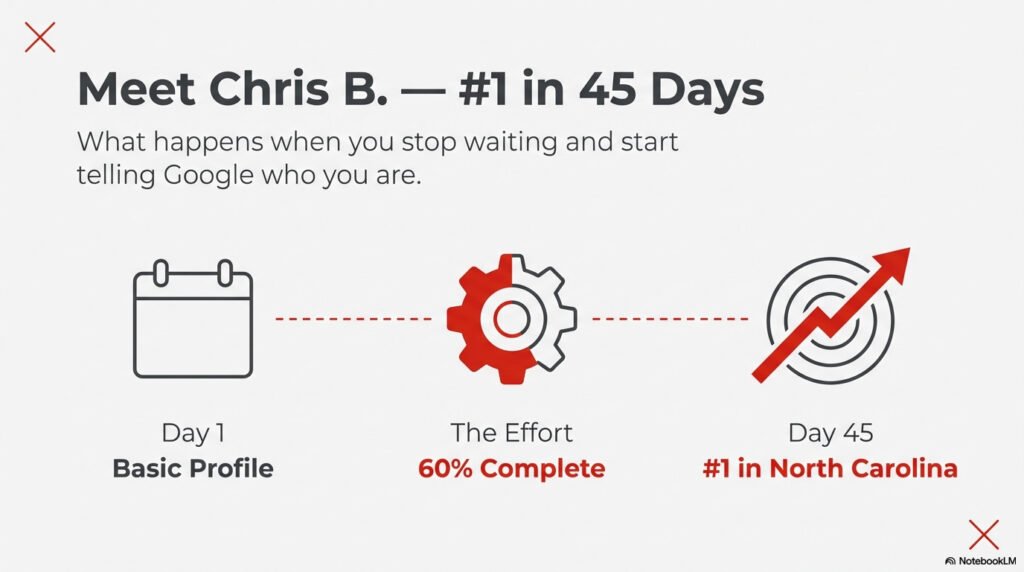
Meet Chris B. — #1 in North Carolina in 45 Days
Before we get into the "how," let me tell you about Chris.
She's a concierge nurse in North Carolina.
Smart, talented, and busy — like most service business owners.
She had a Google Business Profile. It existed. That was about it.
I worked with Chris and taught her what to actually do with her GBP. A few weeks later, she sheepishly told me she'd only done about 60% of what I showed her.
Sixty percent.
Within 45 days, she was getting calls from new prospects.
And today? She ranks #1 for her service in the entire state of North Carolina.
With half the work done.
That's what a properly optimized Google Business Profile can do for a service business. And it starts with understanding why Google cares so much about it.
The Biggest Benefit of Google Business Profile? It Comes Before Everything Else
Here's a question I get a lot: "Should I build my website first, or set up my GBP first?"
GBP. Every time. No question.
Here's why: Google looks at what you've given them directly before it goes hunting for information on its own.
Your Google Business Profile is the low-hanging fruit. It's the information you've handed Google on a silver platter about your business — your name, what you do, where you serve, how to reach you.
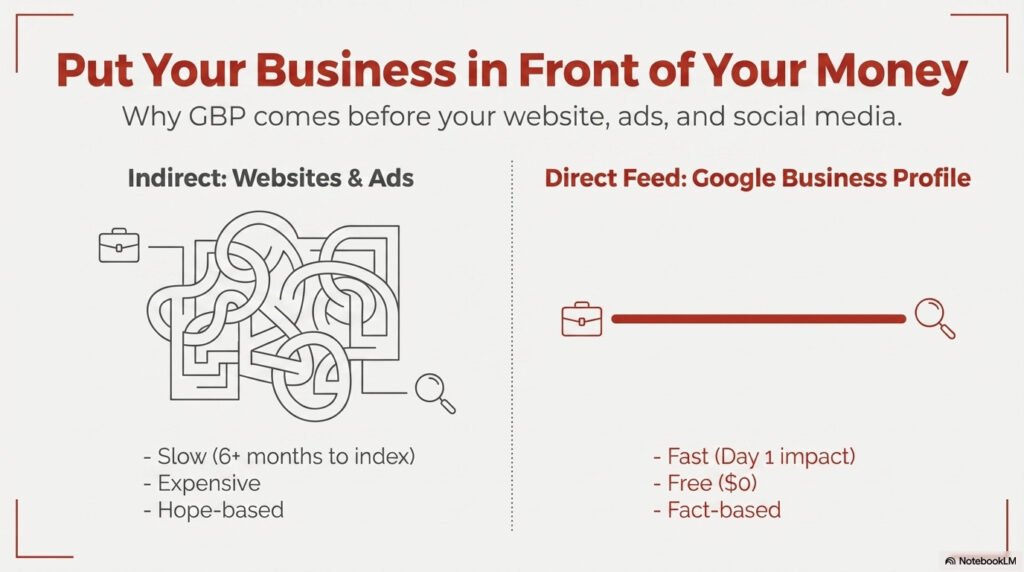
Everything else — your website, your social media, your blog posts — takes time for Google to find, crawl, index, and trust. That can take six months or more.
But your GBP?
You're spoon-feeding Google the correct information from day one. You're cutting their learning curve dramatically.
Chris B. got calls in 45 days because she stopped waiting for Google to figure her out and started telling Google exactly who she is.
Think of your GBP as the front door to your house. It's where everything starts.
Your Yelp listing, your Apple Maps entry, your website — they all have to agree with what's on your GBP. If they don't, Google hesitates.
And when Google hesitates, it ranks you lower.
That's why GBP is priority #1 — above your website, above social media, above paid ads.
Everything else amplifies what's already there.
If the foundation is shaky, nothing else performs the way it should.
The Three Things That Actually Move the Needle
A lot of people treat their GBP like a form they filled out once. It's not. Here's what actually makes a difference:
1. Accuracy — Get Your NAP Right (Down to the Punctuation)
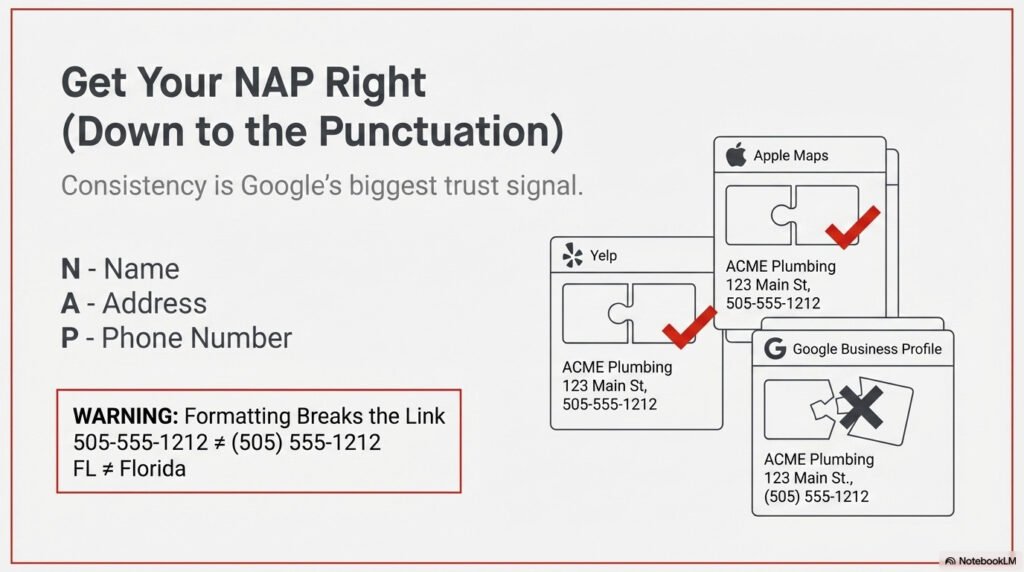
NAP stands for Name, Address, Phone Number. And when I say it has to match across every platform, I mean exactly.
505-555-1212 and (505) 555-1212 do not match in Google's eyes.
FL and Florida do not match.
Google is looking for consistency as a trust signal.
If your phone number is formatted differently on Yelp than it is on your GBP, Google notices. If your address says "Suite 100" in one place and "Ste. 100" in another, Google hesitates.
Go through every place your business is listed online — every directory, every social profile — and make sure the information matches your GBP exactly.
Use your eagle eye. This is the foundation everything else is built on.
2. Local SEO — Tell Google What You Do and Where
Every service you offer is an opportunity to show up in local search.
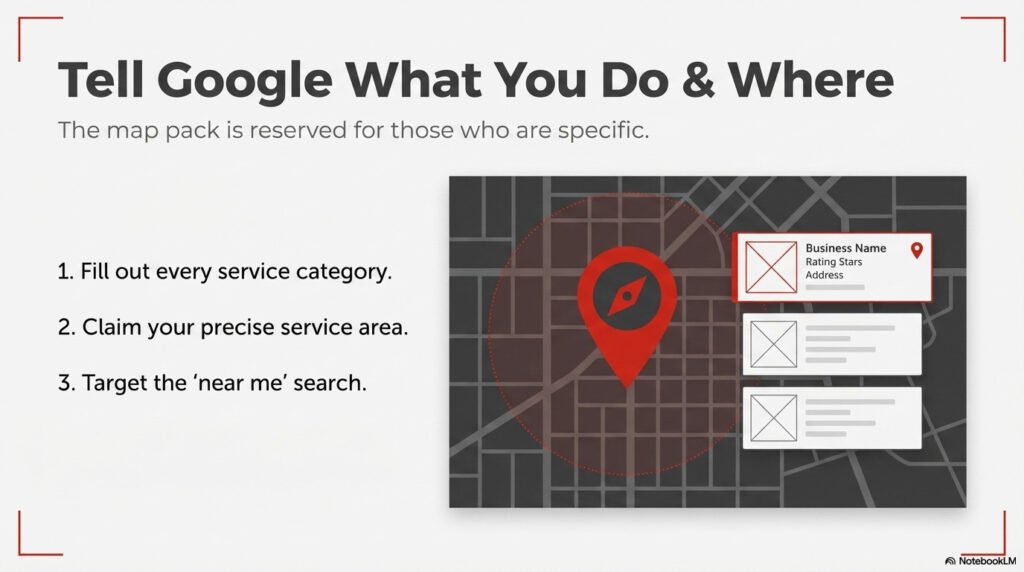
When someone types "life coach near me" or "landscaper near me" or "financial advisor near me" — Google is matching that search to businesses it knows serve that area.
Your GBP is where you tell Google: this is what I do, and this is where I do it.
Fill out every service category. Be specific.
This is how you show up in the map pack — that coveted block of three local results that appears before the organic listings.
Sometimes a business with no GBP loses to a competitor with a complete one, even when the website is better. I've seen it happen.
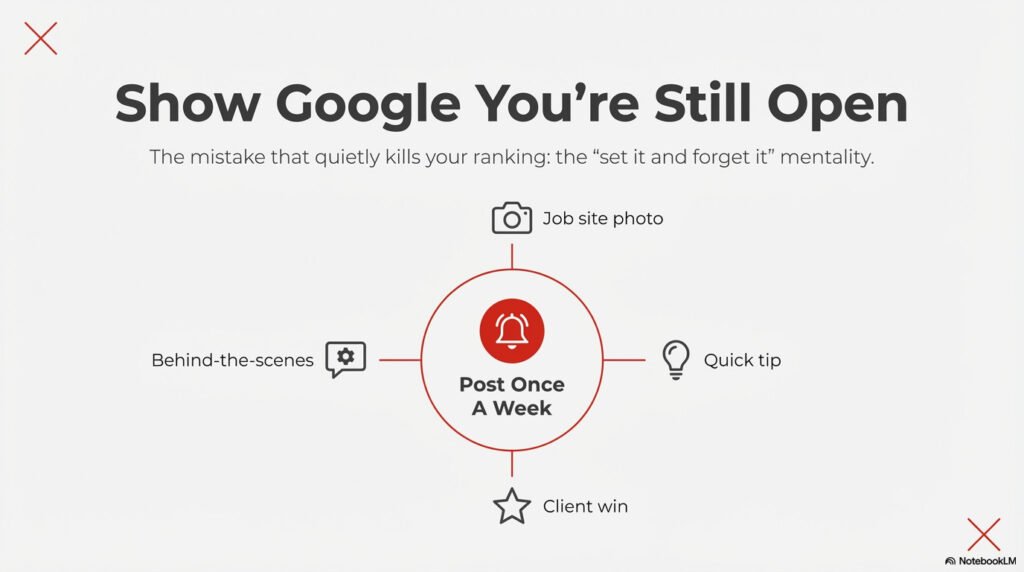
3. Consistency — Show Google You're Still Open for Business
This is where most people drop the ball.
GBP is not "set it and forget it."
Google wants to see that your business is active. It's looking for signals that you're still open, still serving clients, still relevant.
Post once a week. That's it.
It doesn't have to be a production.
·A photo from a job site.
·A quick tip.
·A behind-the-scenes video.
·A client win (with permission).
·A quote graphic you made in Canva in 15 minutes.
How long does it take you to write and send a text? That's all this is. A nudge to Google that says: "Hey, we're still here. Still helping people."
(Need ideas? I've got a whole post on 30 different things you can post to your GBP — bookmark it.)
The Mistake That Quietly Kills Your Ranking
The single biggest mistake I see? Treating GBP like a one-time task.
Business owners spend an hour setting it up, feel good about it, and never touch it again.
Meanwhile, a competitor who posts twice a week — even low-effort posts — starts climbing past them in the rankings.
Google interprets inactivity as a red flag.
An abandoned profile doesn't inspire confidence.
Keep it alive. Keep it fresh.
The bar is genuinely low — one post a week is enough to stay in the game.
Reviews: The Right Way to Handle Them
Reviews are one of the most powerful signals on your GBP. Here's how to do them right.
Get them while the iron is hot. Ask for a review immediately after a great experience — while your client is still excited, still grateful, still riding the high of a great result.
Build the request into your process so it happens automatically. Done right, reviews come in without you even thinking about it.
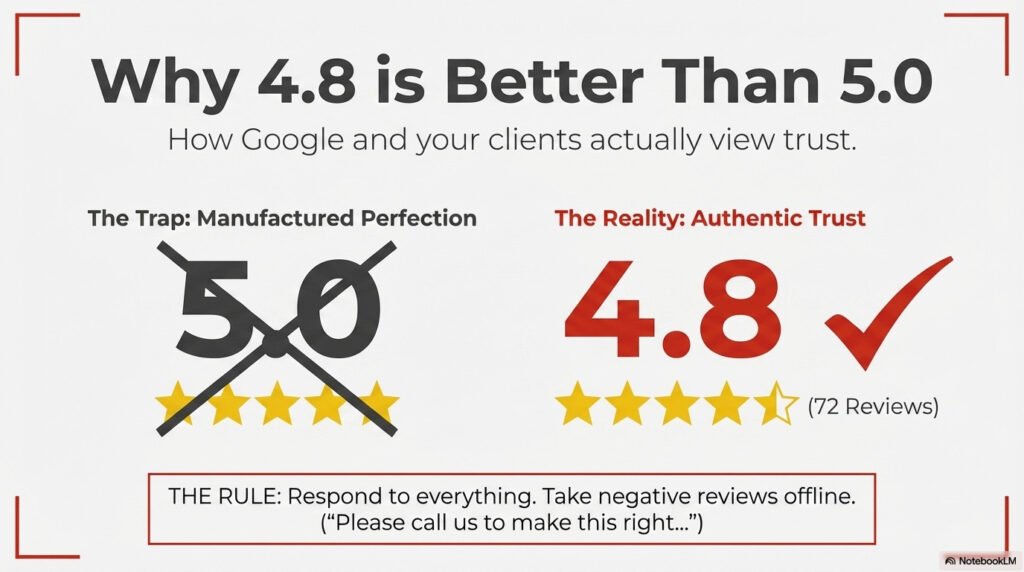
Don't chase a perfect score. This one surprises people: a 5.0 rating with 5,000 reviews is actually less trustworthy than a 4.8 with 72 reviews.
Google knows what a real rating distribution looks like.
An impossibly perfect score looks manufactured — and sometimes it is. There are services that sell fake reviews, and Google is getting better at spotting them.
I've heard of businesses waking up to find 400 reviews wiped out overnight. It can sink a ship fast.
A 4.8 with honest reviews is much more believable. Let the real ones accumulate.
Respond to everything — good and bad. Thank the positive reviews.
For the negative ones, keep it short: "Please call us and ask for [owner's name] — we'd love the chance to make this right."
That's it.
Don't get into a back-and-forth online.
Acknowledge it, show you're proactive, and take it offline. That response isn't for the unhappy customer — it's for every future customer reading the thread.
What Does It Actually Cost You?
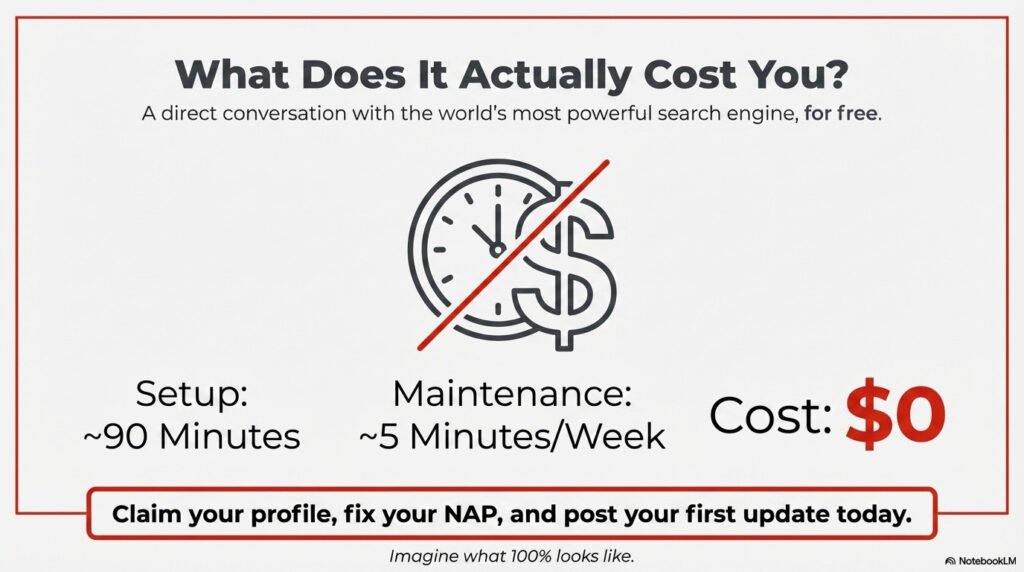
Time. That's it.
Setup takes about 90 minutes if you do it right — it's mostly clicking through options and filling in information you live everyday.
Blast through it in an hour if you just want to get it done.
Weekly maintenance? As much time as it takes to send a text.
If you want to go deeper — a blog post, an infographic, a Canva graphic — you're looking at 15 minutes to 2 hours depending on what you create.
But the minimum viable effort is genuinely tiny.
Compare that to paying an agency $500 to $2,000 to do this for you.
Or spending $2,500 to $5,000 on a website before you've even told Google you exist.
My philosophy for business owners who are just starting out: don't put your money in front of your business. Put your business in front of your money.
GBP plus a single well-built web page is a completely legitimate starting point. Get clients first. Invest in the bigger infrastructure once the revenue is there to support it.
This Is Your Direct Line to Google
Here's what I want you to take away from all of this.
Most marketing tactics are indirect.
ØYou publish a blog post and wait for Google to find it.
ØYou build a website and hope it gets indexed.
ØYou run ads and trust that the algorithm puts them in front of the right people.
Your Google Business Profile is different. It's a direct feed into Google's database about your business.
You're not waiting for Google to figure you out. You're telling Google exactly who you are, what you do, who you serve, and where to find you.
That's the benefit of Google Business Profile that nobody talks about — it's not just a listing. It's a direct conversation with the world's most powerful search engine.
That's a rare and powerful thing. And it's free.
Chris B. used 60% of it and landed at #1 in her state in 45 days. Imagine what 100% looks like.
Ready to Take the Next Step?
Whenever you're ready, here are a few ways I can help:
- What to Post on Google Business Profile Each Week — never run out of things to post
- See What Google Sees — a free Big 3 SEO check so you know where you actually stand
- Google Business Profile Mistakes That Hurt Your Rankings — the errors most business owners don't catch until it's too late
- Join The Marketing Mountain — $25/month (or $250/year — two months free) for step-by-step training on all the free tools available to you, so you never have to pay an agency to do what you can do yourself